How Tire Size Affects Performance and Speed on CartCraft
When it comes to maximising the performance of your CartCraft golf cart, few modifications have as profound an impact as changing the tire size. The wheels you choose directly influence acceleration, top speed, torque, and even battery efficiency. Understanding the relationship between tire diameter and overall drive train dynamics is essential for any CartCraft owner looking to optimise their ride, whether for cruising the estate or tearing up the local course.
This comprehensive guide explores how tire size alters the behaviour of your CartCraft, offering data-driven insights and practical advice. From lift kit requirements to speed calculations, we cover everything you need to know to make an informed decision. We’ll also touch on complementary upgrades such as controller programming to recover lost torque after upsizing.
How Does Tire Diameter Affect CartCraft Top Speed?
Larger tires effectively increase the final drive ratio of your CartCraft without changing any gears. For every revolution of the motor, a larger circumference tire covers more ground. This directly translates to a higher top speed, provided the motor has enough power to turn the heavier load.
For example, a standard CartCraft rolling on 18-inch tires might achieve a maximum speed of 19 mph. Switching to 23-inch tires increases the circumference by roughly 28%, which can push the top speed beyond 24 mph under ideal conditions. However, the trade-off is a noticeable reduction in torque, particularly from a standstill.
The speed increase is proportional to the change in tire circumference, not diameter. Always calculate using circumference: (π × D₂) / (π × D₁) = Speed₂ / Speed₁.
What Happens to CartCraft Torque and Hill-Climbing Ability?
Torque at the wheels is the inverse of speed when changing tire size. As diameter increases, the mechanical advantage decreases. Your CartCraft’s motor must work harder to rotate a larger, heavier tire. This impact is most noticeable when climbing hills or accelerating from a stop.
A CartCraft with stock 18-inch tires can tackle a 30% grade with ease. After upsizing to 22-inch wheels, the same motor might struggle to maintain momentum on a 20% slope without aggressive throttle input. To mitigate this, many owners install a high-torque motor or reprogram the controller. For expert guidance, see our detailed guide on How to Program the Curtis Controller on CartCraft for Maximum Torque.
Here is a comparison of torque loss based on common tire upgrades on a standard 48V CartCraft system:
How Does Tire Width Impact Handling and Ride Quality?
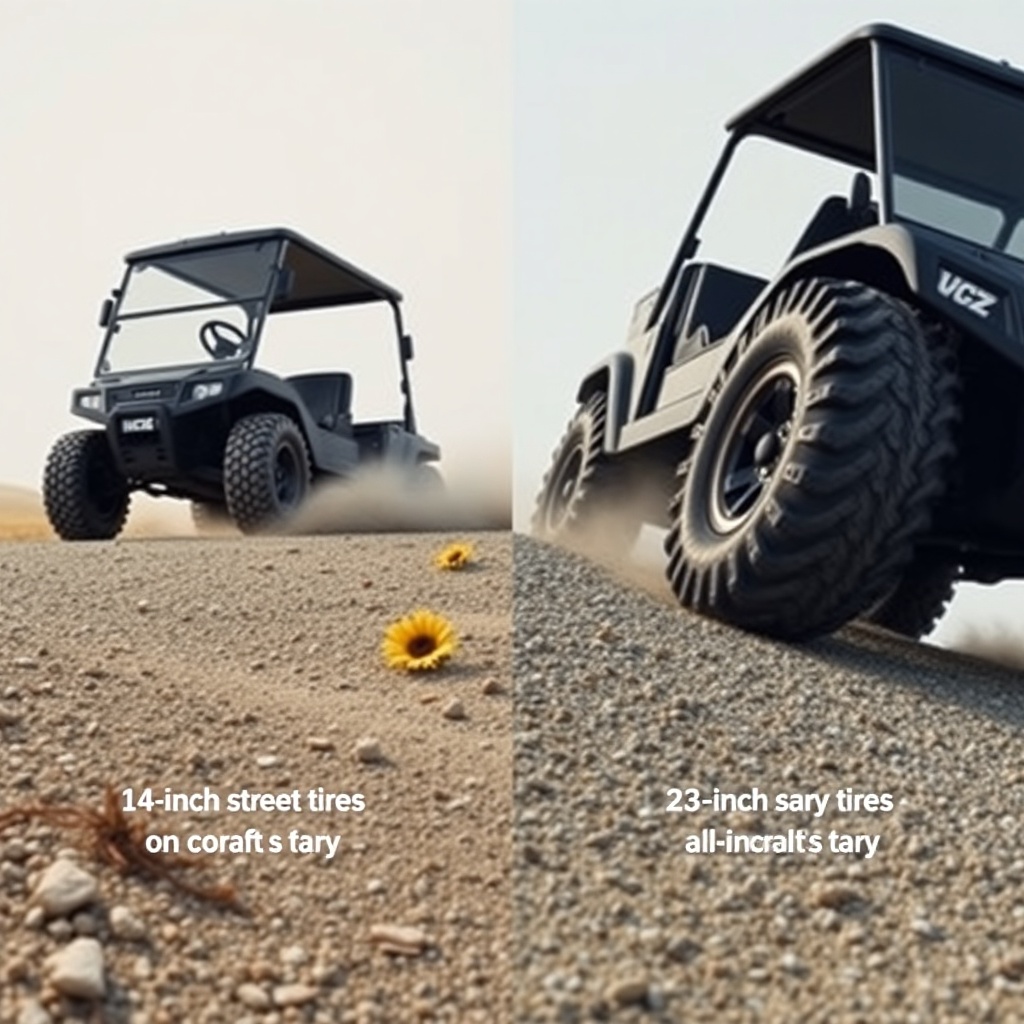
While diameter affects speed and torque, tire width influences stability, steering feel, and rolling resistance. Wider tires—common in 22×11-10 or 23×10.5-12 sizes—provide a larger contact patch. This improves grip on loose terrain and increases cornering stability. However, wider tires create more rolling resistance, which can reduce overall range by 8% to 15% depending on tread pattern and inflation pressure.
Narrower tires (e.g., 205/50-10 street tires) reduce drag and improve efficiency, making them ideal for paved roads and extended trips. They also reduce the risk of rubbing against the CartCraft’s frame or battery box when turning at full lock.
For owners who drive primarily on golf courses or tarmac, a narrower profile often provides the best balance between speed and handling. If you frequent trails or rough terrain, a wider tire with an aggressive tread is advisable, but anticipate a measurable decrease in acceleration and uphill performance.
What Lift Kit Is Required for Larger Tires on CartCraft?
Installing tires larger than 20 inches on a stock CartCraft almost always requires a lift kit. Without adequate clearance, oversized tires will rub against the wheel wells, suspension components, and body panels during articulation or steering.
Here is a quick-reference table for CartCraft tire sizes and the minimum lift required:
| Tire Diameter | Recommended Lift Kit Height | Typical Top Speed (48V Stock) | Torque Loss Estimate |
|---|---|---|---|
| 18″ – 19″ | No lift required | 18 – 20 mph | None (baseline) |
| 20″ – 21″ | 2″ – 3″ lift | 21 – 23 mph | 10% – 15% |
| 22″ – 23″ | 3″ – 4″ lift | 23 – 26 mph | 20% – 30% |
| 24″ – 25″ | 4″ – 6″ lift | 26 – 30 mph | 35% – 45% |
When selecting a lift kit, consider that a taller lift raises the CartCraft’s centre of gravity, which affects cornering. Use heavy-duty shocks and anti-sway bars to maintain safety. Also, longer brake lines may be required for lifts exceeding 4 inches.
How Does Tire Size Affect Battery Range and Charging Frequency?
Larger, heavier tires increase the workload on the motor, which in turn draws more current from the battery pack. On a typical CartCraft with a 48V 230Ah lithium pack, switching from 18-inch tires to 23-inch tires can reduce effective range by 20% to 25% when driving on hilly terrain. On flat pavement, the reduction is closer to 10%.
This increased energy consumption means you will need to recharge more frequently. To offset this, consider upgrading to a higher-capacity battery or optimising your charging routine. Following CartCraft Charging Station Setup: Tips for Faster and Safer Battery Charging can help maintain battery health even under higher load conditions.
Additionally, proper tire pressure becomes critical. Under-inflated tires on a heavy CartCraft increase drag significantly, further draining the battery. Regularly check tyre pressures—typically 18–20 psi for stock tires and 12–16 psi for larger all-terrain tyres.
What Owners Say
CartCraft owners who have upgraded to 22-inch or 23-inch tires report a transformative experience. One owner from Cornwall noted, “After fitting 22-inch tires and a 3-inch lift, my CartCraft feels like a completely different vehicle. I can traverse muddy paths near the coast that were impossible before. The top speed increased from 19 to 23 mph—plenty for the village roads. I did lose some pull on the hills, but programming the controller for more torque sorted that out.”
Another owner in Surrey, who uses his CartCraft for estate maintenance, shared: “I kept the stock 18-inch tires for daily work because the 22-inch tires cut my range by about 16% on my regular circuit. They look fantastic, but for my needs, the smaller tires are more practical. I learned the hard way that bigger isn’t always better if you need all-day runtime.”
Many owners stress the importance of recalibrating the speedometer after a tire change, as the factory reading becomes inaccurate. A GPS-based speedometer app is a simple fix, or you can reprogram the controller via the Curtis handheld programmer.
Frequently Asked Questions
1. Can I install 23-inch tires on my stock CartCraft without a lift kit?
No. 23-inch tires will rub against the frame and wheel wells during turns or suspension travel. A minimum 3-inch lift kit is required to provide proper clearance.
2. Will larger tires void my CartCraft warranty?
It depends on your dealer and region. Many manufacturers consider tire and lift kit modifications as aftermarket changes that may void drivetrain or suspension-related warranty claims. Always check with your CartCraft service centre before installing oversized wheels.
3. How do I calculate my new top speed after changing tire size?
Use the formula: New Speed = Original Speed × (New Tire Circumference / Original Tire Circumference). For example, if your CartCraft originally did 19 mph on 18-inch tires (circumference 56.5 inches) and you switch to 23-inch tires (circumference 72.3 inches), your new speed is about 24.3 mph.
4. Should I reprogram the speed controller after a tire upgrade?
Yes, especially for torque recovery. The Curtis controller on CartCraft can be reprogrammed to increase current limits and adjust throttle responsiveness. For detailed steps, refer to our guide on controller programming.
5. How much does it cost to change CartCraft tires and install a lift kit?
A set of four aftermarket tires and wheels typically costs between £400 and £1,200 depending on brand and size. A 3-inch lift kit costs around £250 to £600, plus installation labour (approx. £150–£300). Total investment ranges from £800 to £2,100.
6. Are larger tires harder on the battery?
Yes. The added rolling resistance and weight require more energy, reducing your range by 10% to 25% depending on terrain and driving style. To compensate, follow CartCraft Battery Charging Best Practices for Extended Battery Life to ensure your battery stays healthy under increased load.